Showing posts with label Vinnie Bell. Show all posts

Sunday, January 19, 2025

   4. Space Age Pop: What on Earth is it all About?

 Bruce Corneil


It can be as dramatic as Henry Mancini’s “Peter Gunn”, as mysterious as Martin Denny’s “Quiet Village” or as playful as Floyd Cramer’s “On the Rebound”. From Les Baxter’s “Poor People of Paris” through to Cozy Cole’s “Topsy Part 2” and Herb Alphert’s “Lonely Bull”, the musical colors of Space Age Pop are not only many and varied but also extremely vivid.

The sound was up-market contemporary and, for a while, it was everywhere on radio, TV and in the movies. Yet, for years it remained a genre without a name. It wasn’t until the 1980s that Los Angeles film-maker and record collector Byron Werner coined the phrase “Space Age Bachelor Pad Music”. Later changed to its present form, the term is now used to describe a particular style of easy listening pop which rose to prominence in the US after Word War II. Although no specific recording or date marked its exact starting point, its golden days were from the mid- '50s up to the time of the Beatles invasion of America. Mainly instrumental, album-based and adult-orientated, its creators frequently drew their inspiration from such diverse sources as modern jazz, Latin, country and rock ‘n roll. However, all these influences were skillfully homogenized in order to make them more appealing to a wider audience. But conquering the jukebox was never a priority. These discs were primarily in the business of bringing fun and entertainment into the living room by way of giving the family stereo a workout with lots of cross-channel movement (when that technology became available in the late 1950s)


Brad Bigelow, the man behind Space Age Pop.com (www.spaceagepop.com), the internet’s most comprehensive guide to the subject, says that this music cannot be easily categorized. “It’s in some middle ground and, as a result, it’s full of brilliant, bizarre and exciting sounds” Bigelow explains.

It all began with the introduction of LPs which made it possible to listen to records for longer, uninterrupted periods while high-fidelity and stereo provided vastly superior and more “life-like” reproduction. Albums had the potential to create a range of different moods which were just right for the modern American home. Hi-fis, (later to be known as “Stereos”), became an essential part of fashionable décor and an important status symbol. Preferably situated on polished floorboards, surrounded by Danish furniture and stone feature walls, they immediately identified their owners as being forward-thinkers. The rush to “Tomorrow Land” was on. Americans would soon be reaching for the moon while they stood knee-deep in LPs.

The genre is made up of several sub genres with each one boasting its own stable of artists.

Space Age Bachelor Pad” gets the ball rolling by supplying a jaunty soundtrack to after-five shenanigans. The story goes that Byron Werner initially used the label to describe the recordings of Juan Garcia Esquivel who specialized in  complex arrangements. Contracted by RCA in '57, Esquivel reached his peak with the album Latin-Esque.Exotica” offers the chance to take the “big trip” and it comes in two varieties – Jungle and Tiki. The so-called “Jungle School”, established in 1951 by the composer-conductor Les Baxter with his LP Ritual of the Savage for Capitol, is where it all began.Tiki invites the hi-fi buff to “Go Hawaiian” and drift away for musical adventures in paradise. Cool jazz pianist Martin Denny was the Boss man in charge of the Tiki hut where an attractive combination of lilting vibes, conga drums, bamboo sticks and Buddhist temple bells perfumed the air. Denny struck gold in '59 with “Quiet Village”, a sultry and hypnotic evocation of Pacific island life, complete with squawking birds and other environmental noises (see top of page). Exotica takes its name after from Denny’s debut album.


Esquivel Latin - Esque (left) Les Baxter Ritual of the Savage (center) Martin Denny Exotica (left)


Jet Set Pop” was the successor to Space Age Bachelor Pad and it encompassed the likes of Herb Alpert, Sergio Mendes and some of the more sophisticated movie music of the day such as John Barry’s “007” theme.


The Now Sound” latched onto the rhythms and instrumentations of rock ‘n roll. An MOR response to the Go-Go fad of the mid- 1960s, its leading exponents were big band veterans. Les and Larry Elgart, for example, joined forces with arrangers Charles Albertine and Bobby Scott to produce a couple of crackerjack albums which included Elgart au Go-GoCocktail” music is self explanatory. This was the stock in trade of all those piano trios which provided a pleasant backdrop to the “Lounge” bars of the world. Irving Fields was one of the star performers in this department.


Herb Alpert Lonely Bull (left) Les Elgart Elgart au Go - Go (center)
 Irving Fields Trio That Latin Beat for Dancing Feet (right)


From the start, the genre became an epicenter of artistic and technical innovation. Showcasing the talents of top composers, arrangers, producers and session players, it championed the use of many unusual instruments in popular music and pioneered stereo engineering. Bigelow believes that its contribution to the industry has gone largely unrecognized. “It introduced bossa nova, exotic percussion, electronic and other new sounds to mainstream pop” he says. However, a zany sense of fun was always close at hand in the midst of all the legitimate experimentation. As proof, a deeper plunge into this fascinating box of vinyl curios will uncover such gems as Bagels and Bongos, Zither Goes to Hollywood Accordion Fireworks and the Nutty Squirrels . Or, how about a honky-tonk piano version of the Beatles “Hard Days Night”? Even a few spoken word records can be found in the mix just to add a touch of spice.
Constantly trying out novel ideas was very much a part of the whole thing. And that’s precisely what the guitar duo Santo and Johnny did in  '59 when their composition “Sleep Walk” went straight to number one. A haunting instrumental, the tune itself was both striking and memorable. But it was the arrangement that really caught the public’s attention. With Johnny laying down a slow pulsating backbeat with his standard electric guitar, Santo etched out the melody line on a steel guitar. The result was a revelation. Hawaiian flavored pop was born and it sold a million – literally. The duo was comprised of brothers Santo and Johnny Farina from Brooklyn, New York. As kids just starting out in the business, the Farinas had to pound the streets of Manhattan with nothing more than a cheaply recorded demo in their quest to find a buyer for their brainchild. “I had to push “Sleep Walk” for over a year’ Johnny recently recalled. “Nobody was prepared to listen to a steel guitar in rock ‘n roll at that time”. Finally, the small Canadian-American label decided to take a chance and the rest, as they say, is history. Although the track is now considered to be a classic of the genre, it was well received by both adults and teenagers when it was released. Farina has no doubt as to why the record was able to breakthrough. “The sound of the steel guitar is unique to begin with and the way we used it was different as well” he explained.

Johnny Farina


Another guitar man who loved to experiment was veteran studio musician Vincent “Vinnie” Bell. Still around and playing better than ever, Bell joined the Space Age Pop race in 1956 when he worked on the Les Elgart LP For Dancers OnlyHis fancy picking can also be heard on dozens of major hits from Wilson Picket’s “Funky Broadway” and the Monkees "I'm a Believer" to Frank Sinatra’s "New York, New York”. 


Vinnie Bell (centre)
 with fellow guitar legends Al Caiola (left) and Tony Mottola (right)


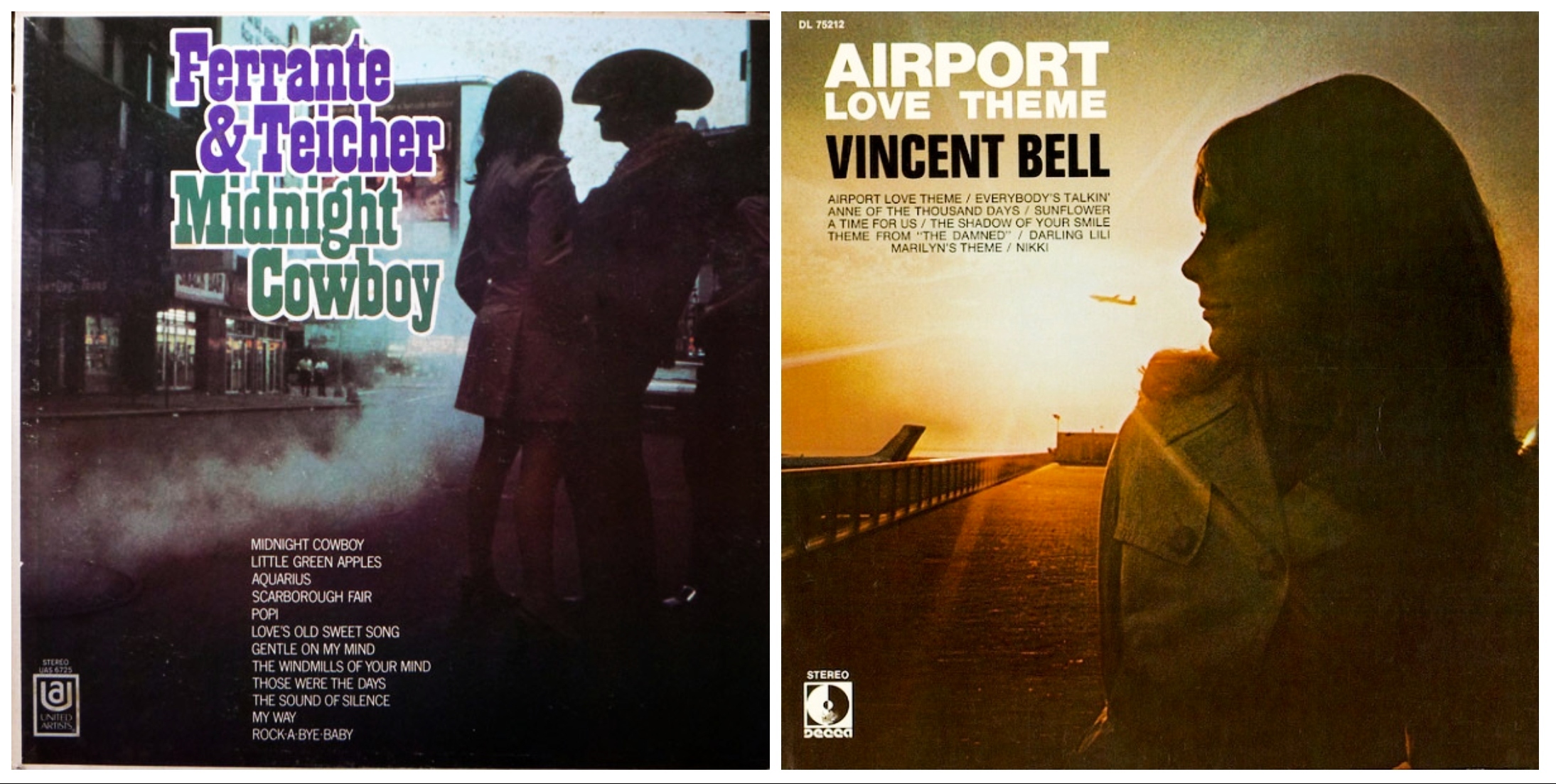
A popular recording artist in his own right, he is, perhaps, best known for his “watery" guitar sound which seemed to be everywhere at one point in the  1960s. Featured on “Midnight Cowboy”, the gold single from '69 by pianists Ferrante and Teicher, it also gave its inventor his own million-seller the following year when he recorded the love theme from Airport. Vinnie has remained tight-lipped for decades in regard to how he came up with the effect. After some gentle prompting, however, the genial axe man agreed to lift the veil of secrecy just a little. “Since 1952, I had been using a special FX bank of fourteen circuitry pedals which I designed and built” he revealed. “One of them makes the underwater sound when it’s depressed”.


Ferrante & Teicher Midnight Cowboy album (left) Bell's Airport love theme album (center and right)


Bell’s interest in left-field ideas brought him into contact with French tape wizard Jean Jacques Perrey, a pioneer in electro pop who had relocated to New York.  Perrey's 1966 album The In Sound from Way Out is considered a classic of both space age and electronic pop. "Jean Jacques came to the US in the early ‘60s with an electronic keyboard instrument called the Ondioline which none of us had heard of ” Vinnie remembers. “On our first session we joined the remarkable trombonist Kai Winding. I played the guitar solo. Jean Jacques played the Ondioline”. The track the talented trio recorded was “More”, the theme to the dubious shockumentary Mondo Cane and it quickly zoomed up the charts.


Perrey demonstrated the Ondioline (lower right corner in front of piano keyboard) on American television (left)
Kai Winding's Top 40 hit "More" (center)
 Jean Jacques and Vinnie around 2010 (right) (Dana Countryman photo)

https://www.youtube.com/watch?v=T-kaquSOLo4


Invented in 1941 by Georges Jenny, the Ondioline was the forerunner of today's synthesizers. It was not only capable of making all sorts of weird and interesting effects of its own, it could also simulate the sounds of a wide variety of traditional instruments with great realism. Space Age Pop historian Dana Countryman has written a biography about Monsieur Perrey entitled Passport to the Future : The Amazing Life and Music of Electronic Pop Pioneer Jean- Jacques Perrey (right).  

Bell was also very much a technical whiz. In addition to his aforementioned "watery" guitar he came up with several new instruments which included the Danelectro Bellzouki and the electric sitar, the latter of which he played on the Lemon Pipers hit "Green Tambourine" ('67)


Vinnie in the studio around 1967 / 68 with his electric sitar (left) The Lemon Pipers 1967 hit "Green Tambourine" 
on which Vinnie played the aforementioned instrument (center) With the Danelectro Bellzouki (right) 
(Photos left and right from Stereo Candies)


Few solo singers came to the fore in this genre. However, several vocal groups did make an impression with the most prominent one being organized by Ray Conniff. A former trombonist and arranger with the Harry James orchestra, Conniff became a key figure at Columbia in the 1950s. But he really made everyone sit up and take notice with his extraordinary “wordless chorus”. Based around four male and four female singers, the guys and gals replicated the sound of an orchestra’s brass section by singing such memorable lines as “Bah-Doo-Wup-Bah-Doo-Doo-Wuh”. The shoppers loved it and Conniff'c career went ballistic thanks to albums such as S’ Wonderful ('56) and Concert in Rhythm (’57).

Ray Conniff Singers (Conniff at far right)


And what would Space Age Pop be without its string groups? Annunzio Paolo Mantovani set the style. With his romantic sound being variously known as the “Gush of Lush” and “The Niagara Falls of Fiddles”, Mantovani churned out half a dozen gold singles and eight gold albums between 1951 and ’61. He summed up his own success in very simple terms: “Maybe 25 percent of people like the Classics and 25 percent like the Beatles. I aim to please all those in the middle”.


Mantovani displays one of his gold records (left) Two of his top selling albums Film Encores (center) and Exodus (right)

https://www.youtube.com/watch?v=EyiXp9ctqpk


The Beatles may not have been the pin-up boys for the average Mantovani fan but Hollywood maestro Stu Phillips (left) could hear tremendous potential in the Fab Four’s better songs. “I was an A&R man at Capitol in 1964 when the Beatles first US album was to be released” Phillips says. “I suggested that it might be interesting if their music was recorded instrumentally and made more palatable to an older market”.

With Phillips at the helm as arranger, producer and conductor, the label assembled the Hollyridge Strings and their LP The Beatles Song Book (right) did surprisingly good business. To quote Brad Bigelow, ”The concept gave Muzaka shot in the arm and the rockers a rich supply of nightmares”. Phillips was instantly attracted by the quality of the Beatles compositions: “Those Lennon and McCartney songs were melody-driven that’s why I thought they would make great instrumentals. I tried to pick songs that I thought were going to become standards”.


Just as intriguing as the music of this genre was the way in which it was sold. Usually without the beaming faces of major celebrities, album covers had to work hard to separate consumers from their cash. As part of the strategy bold, risqué and even frightening graphics backed onto equally captivating descriptive text which rhapsodized about the sonic delights that were on offer. And irresistible titles such as Mallet Mischief, Primitiva, and Blast Off! were sure to sway the undecided. Promising pure escapism, covers promoted futuristic, exotic and sexy images.


Christopher Evans, a life-long vinyl collector based in Belgium, has put together the website Space Age Pop a-Go-Go.com which is entirely devoted to scans of classic covers. Evans, who has made a detailed study of this form of commercial art, says that the record companies liked to emphasize stereo gimmicks. “There was “Spectra Sonic Sound” and “Wall to Wall Stereo” while RCA pulled out all the stops by assuring its customers that “Stereo Action is musical movement so real, you’re eyes will follow the sound” Evans recites without missing a beat. He has a particular fondness for Les Baxter’s Space Escapade : “Two good-looking bachelor spacemen having a cocktail with a couple of extraterrestrial girls. Pure kitsch”. Sometimes the pop peddlers relied on shock value. Tiki artist Arthur Lyman’s LP Taboo, for instance, displayed a shrunken head.


Widely reviewed, these albums were the preferred listening option for most adult record buyers along with their daily shots of Sinatra, Dean Martin and Peggy Lee. But, of course, public tastes inevitably change. In time, the novelty of stereo wore off while major political upheavals and the phenomenal rise of the Beatles had a profound and enduring impact on the music scene. And it wasn’t necessarily all for the best. Some of those who were a part of the business throughout the Beatles era and beyond still feel a sense of sadness as they look back on the gradual disappearance of musical variety from the radio airwaves. Stu Phillips is one of them. “I guess a lot of those people who grew up with rock felt that light hearted instrumentals were corny” he says. Vinnie Bell on the other hand, thinks that the industry itself must take some of the blame. In its rush to cash in on mainstream '60s pop, a pack mentality developed and increasingly restrictive programming in commercial radio became the norm. “My belief is that the spontaneity among session men was halted and everyone started to copy each other. The spark went out of the whole thing” he laments.
1970s logo for Beautiful Music
 station 3AK in Melbourne,
Australia 

Bigelow is able to shed further light on the reasons for the decline: “The original fans of Space Age Pop lost interest in buying records. Also, Beautiful Music stations were being established all over the country and older people shifted from playing LPs to listening to those stations”.

As it turned out, the genre had to wait a long time to be rediscovered. As popular as it was in its day, it was largely over-looked by the first retro boom that got underway in the 1970s in the wake of American Graffiti.

The revival began slowly in '93 with the publication of two books – Joseph Lanza’s Elevator Music : A Surreal History of Muzak, Easy Listening and other Mood Songs (below left) and Incredibly Strange Music (below center), a two volume set by Re/Search Books. A little later, the musician and writer Dana Countryman came out with Cool and Strange Music (below right). (www.weirdomusic.com). Then, the Exotica mailing list was launched on the internet and Capitol released its series of Ultra-Lounge CDs.


Books : Elevator Music (left) Incredibly Strange Music (center)
Cool and Strange Music (left


Selection of Capitol's Ultra - Lounge CD collection : Exotica (left)
 Tiki (center) and Christmas Cocktail music (left)

On the vinyl front, some of the more hard to find, original albums are now attracting plenty of bids on eBay. Christopher Evans has watched prices climb over recent years. “LPs such as Les Baxter’s Space Escapade in stereo and in good condition often sell for over $100 US” he says.

Space Age Pop has made its presence felt on alternative radio as well. An ideal starting point for your “listening pleasure” would be Bigelow’s website which offers a link to a continuous stream of music which comes from the net broadcaster, Basic Hip . Darrell Brodgon, presenter of the program “Retro Cocktail Hour” on Kansas Public Radio (and the net) says that the genre attracts a lot of drive-by interest. “I’m constantly impressed, however, by how many people are drawn to this music once they’ve been exposed to it” Brogdon enthuses. Also doing their bit to keep the flag flying is LuxuriaMusic, a Los Angeles-based internet station. Program Director Chuck Kelley shares the view that interest appears to be on the rise. “I think it’s increasing. I see new people in the chat room every day” Kelley says. Brogdon and Kelley also agree that 1950s Exotica and particularly Tiki music is the big deal with their listeners at the moment.


Chuck Kelley (left) Publicity for Luxuria Music's current membership drive (center)
 Darrell Brogdon host of Kansas Public Radio's "Retro Cocktail Hour"


In a further gesture to educate the uninitiated, Bigelow provides a list of Top 10 albums, many of which have been mentioned here. But one in particular, Enoch Light’s Persuasive Percussion, holds a special place. Both a brilliant musician and a technical genius on the knobs and wires side of things, Light owned the Command label and the aforementioned disc was, until recently, ranked among the Top 25 best-selling albums of all time. Or, for something completely different, you might like to track down a copy of the Cold War instructional disc If the Bomb Falls which explains how to survive a nuclear attack.


Brogdon’s final thoughts on the subject pretty well sum up the sentiments of other devotees of these quirky sounds. “Its upbeat and futuristic spirit, together with the incredible professionalism of these old records is a joy. I also like the fact that, in those days, there were more choices for the consumer. Today, the record business is all about money and jamming the same old stuff down our throats over and over again” he states emphatically.

Of course, not all Space Age Pop was outstanding. Like every category of music, it produced its share of duds and dazzlers. When listening to these albums today, however, it’s worth remembering that they were recorded using only basic analogue technology. With the end product being physically cut and spliced together, there was a high element of art involved in the process and, on balance, what they came up with was pretty darn amazing. As Johnny Farina says “There was no comparison to the studios of today. Actually, you had to be much more creative and resourceful in the early days because the equipment was so primitive”.

But, perhaps, Joseph Lanza, the man who was primarily responsible for the rediscovery of the genre, should be given the last word. Summarizing the main value of this type of music in his aforementioned book, Lanza stated his views quite simply.....

After decades of rock, rhythm and blues, folk and wrap, a desensitized population seems to assume that if music is not heavy, loud and steaming with emotion or anger it is somehow less than good. However, there is still a place for gentler sounds that are subdued, unobtrusive and even remote which can make us feel relaxed and distracted from the troubles of the world”.


The above piece is based on a magazine article that was published some years ago. 

Author : Bruce Corneil - former radio music programmer and recording engineer 

   5.Vinnie Bell - Guitar Legend


An interview 
with veteran studio musician Vincent "Vinnie" Bell: Guitar man to the stars
____________________________________________________ 

Mr Bell was contacted along with several other American music industry identities for a magazine article that I wrote some years back about Space Age Pop and the main emphasis of our discussion was placed on the work that he did in that easy listening instrumental genre : https://backinthedayblogspot.blogspot.com/search?updated-max=2023-05-30T02:09:00-07:00&max-results=7&start=1&by-date=false

Born Vincent Edward Gambella on July 28,1932 in Brooklyn, New York, the genial axeman passed away on October 3, 2019 in Tenafly, New Jersey at the age of 87. A highly respected "behind the scenes" talent and a million-selling recording artist in his own right, he is, perhaps, best remembered as the inventor of the bubbly "underwater" guitar sound. We communicated on several occasions and I very much appreciated being given the opportunity to document some of his memories.
____________________________________________________________________________________________________________

Bruce: Vinnie, great to catch up with you. Thanks for finding the time to have a chat  

Vinnie: Likewise Bruce. Nice to hear from Australia
  
Bruce: I used to work at a radio station where the promotional slogan was "Hits and Memories" and I was reminded of that line as I looked through your incredible list of recording credits. Indeed, you've played on so many million - sellers. But just to reel off a few of them as an introduction... they include such  chart toppers as the Monkee's "I'm a Believer" , Stevie Wonder's "Signed, Sealed, Delivered", Frank Sinatra's "New York, New York", "Color my World" by Petula Clark, Dionne Warwick's "Walk on By" , Del Shannon's "Runaway", "My Boyfriend is Back" by the Angels, the Lovin" Spoonful's "Summer in the City" and "Sugar, Sugar" by the Archies. You had your own gold record with the love theme from the movie Airport. Your guitar work was also prominently featured on Ferrante and Teicher's "Midnight Cowboy" and the soundtrack of the TV series "Twin Peaks" and Vincent "Vinnie" Bell is that your funky pickin" on the opening bars of Wilson Pickett's "Funky Broadway"?

Vinnie: Sure is..... the Wicked Pickett they called him .....

(Live on stage in Los Angeles in the 1960s)

(Wilson's Pickett's "Funky Broadway")


Bruce: It's a solid gold hit list of classics from the '60s, '70s, '80s and beyond and I'll include a much more extensive rundown of them at the end of this piece. However, I know that your career extends into other areas of the industry and we'll also discuss that a bit later. But, first up, where did it all begin?  

Vinnie: It all started around 1950 in New York City when I was a teenager and got my first guitar 
  
A young Vincent Bell in
 New York circa 1950s (danacountryman.com)


Bruce: You're from New York originally?

Vinnie: Born and bred. Although I have lived in New Jersey for a long time.

Bruce: Has most of your session work been in New York?

Vinnie: New York and LA

Bruce: Were you self-taught as a guitarist or did you have lessons?

Vinnie: I studied for a number of years with two of the best players in town - namely Carmen Mastren and Tony Mottola
 
Bruce: I seem to recall that Tony appeared on one of Frank Sinatra's television specials in the ' 80s, possibly Sinatra's "Concert for the Americas": a show that was produced in the Dominican Republic

Vinnie: He did. Both Tony and I backed Frank in the studio as well as on stage


(Tony Mottola and Frank Sinatra ''Send in the Clowns")

(Tony shares his memories of working with Mr Sinatra)

(Left to right) Vinnie Bell, John Pisano and Tony Mottola
(Dana Countryman photo)


Tony Mottola - Wikipedia


Bruce: That must have been quite an experience. What was Frank like in those situations?

Vinnie: He was a technically perfect singer... a superb stylist and he had amazing charisma.

Bruce: Demanding?

Vinnie: Of course. But that's what made him an outstanding artist.... his pursuit of excellence. He had high standards. So do I. It's easier to deal with people who know what they want. On a personal level, he was a very sharp guy who had a terrific sense humor 


(New York Theater)

Bruce: How did you get your break as a professional musician ?

Vinnie: I got the ball rolling in the '50s playing at various night spots in New York. I also had a group called the Gallahads. Then I managed to pick up a few studio jobs. Finally, I decided to quit the club scene to concentrate, almost exclusively, on  recording

Bruce: Was it difficult to get a foot in the studio door as a session player?

Vinnie: Yes, it was fairly competitive, particularly in New York where there is so much talent. A lot of guys wanted to get away from the grind of the club scene. Session work was generally more convenient and better paid... at least it was from me. I had a couple of contacts, such as Tony, who helped me to get going 

Bruce: Do you play any other instruments apart from the guitar?

Vinnie: I do but they're all similar... acoustic and electric guitar also mandolin, banjo and ukulele

Bruce: You played that iconic mandolin on the soundtrack of the original Godfather movie. How did that come about?

Vinnie: I got an offer I couldn't refuse..... boom.. boom...oops.. I mean...only kidding. I knew someone who was involved in the production

Original movie poster and soundtrack album (1972)

(Original theatrical trailer for The Godfather ) 


Bruce: For those who don't know, what sort of projects do you work on as a studio musician? Presumably, there's more to it than constantly churning out Top 40 hits  

Vinnie: Correct. As you would be aware, only a fraction of the music that's recorded becomes extremely popular or even gets radio airplay. But, of course, much of it isn't produced with that objective in mind. I've done all kinds of jobs from TV and movie themes to documentaries, promotional films, many, many advertising jingles....etc.. etc.. etc...

Bruce: What does it take to be a successful session player?

Vinnie: Mainly, you have to be versatile - that is willing, able and enthusiastic to play different styles of music across just about all genres. Also, you must respect the producer's authority and give them what they want. You can make suggestions and offer ideas. But don't argue. They're giving the orders
   
Bruce: What do you like most about doing sessions? 

Vinnie: Well, I could just go back to what I said before. There's always something new in the pipeline. As far as albums and singles are concerned, I've really enjoyed working with artists who have come from different musical backgrounds because I  listen to a broad cross section of genres. And, yes, you certainy get a special buzz contributing to a major hit. But, again, that's only part of the musical kaleidoscope

Bruce: Is there anything that you don't like about it?

Vinnie: I honestly, can't think of anything

Bruce: You mentioned that you started in the 1950s and I've seen your name cropping up in connection to the band leader Les Elgart. My favorite instrumental album of that decade is Elgart's For Dancers Only although I didn't discover it until the '70s when I was rummaging through my parent's record collection. Just wondering if that's your melancholy strumming that we can hear on the Earle Hagen composition "Harlem Nocturne" which is included on the album? 

Vinnie: It is. That was one of the very first studio jobs that I got and it did quite well on the charts

Family heirloom:
The author's well-worn original 1950s copy of the
 Les Elgart album For Dancers Only

Band leader Les Elgart (left)(Wikipedia)
 and an early Vincent Bell publicity shot (Stereo Candies) 


Les Elgart - Wikipedia

(Vinnie's guitar featured on the track "Harlem Nocturne")


Bruce: Right... and, of course, Les Elgart's band played the theme to Dick Clark's famous TV show American Bandstand

Vinnie: They did. It was called "Bandstand Boogie". Written by Charles Albertine and a great, swinging, brassy arrangement. Then Barry Manilow did a vocal version in the '70s when '50s nostalgia was all the rage. And, by the way, Charles did all the arrangements on For Dancers Only

Bruce: I didn't know that. Les also recorded a dynamite version of Big Joe Turner's "Flip, Flop and Fly" with singer Johnnie Ray

Vinnie: Correct. I remember that


Bruce: Vinnie, there seems to have been three, separate parts to your career which you have pursued simultaneously.  One has been your work as a studio musician. Another was establishing yourself as a successful solo recording artist and the third is your involvement in the technical production side of the industry. In fact, you were a pioneer in several instances where you invented a number of guitars and guitar - style instruments along with other pieces of equipment which  produced some interesting sounds. When did you start to experiment with music related technology?

Vinnie: Oh, almost as soon as I took up the guitar. My friend and mentor, Les Paul was already blazing a trail in regard to electric guitars, overdubbing, phasing and delay effects and he was using them on records such as "How High the Moon". He  inspired me. I was always interested in electronics and, like Les, I combined that with my aptitude for playing 

Les Paul and wife Mary Ford (1950s)

https://www.youtube.com/watch?v=NkGf1GHAxhE


Bruce: The effect for which you're best known is your bubbly "underwater" or "watery" guitar sound which will be familiar to many from Ferrante and Teicher's Top 10 cover version of the theme from "Midnight Cowboy" and your own million-seller which was the love theme from Airport. I'm going to provide links to those tracks when this interview goes online. Are we allowed to ask how that particular effect is created? For example, can it only be made on a special guitar or do you prefer to keep that information confidential?


Vinnie's pic from the back of the Airport Love Theme album


(The theme from Midnight Cowboy featuring Vinnie's "watery "guitar)


Vinnie: Frankly, I do prefer to keep the precise details to myself because it's become a trademark for me. However, just to offer some sort of response, the short answer to the second part of your question is "no". It has nothing to do with a special guitar. It is generated on an effects unit; the prototype of which I built back in the ' 50s. It has fourteen circuitry pedals and one of them makes the watery sound 

Bruce: There's a rather witty photo on Dana Countryman's website which suggests another possibility as to how you came up with the "bubbly bit" which I might include with this piece 

Vinnie: Please do. In fact, I think I'll use that shot as my Facebook profile pic .....although, in all honesty, I was a bit out of shape at the time...  
 
(Dana Countryman)


Bruce: When was the underwater effect first used on a record?

Vinnie: 1959's "Barracuda" by the Gallahads....was, perhaps, the earliest but the sound wasn't quite as smooth as it became later

The Gallahads (1956?) Vinnie Bell (right) and their RCA disc "Barracuda" 

(NOTE:  As I now understand, the Gallahads were mainly a doo wop vocal group; something that I wasn't aware of
 when I was in contact with Vinnie. However, "Barracuda" is definitely an instrumental track that features his guitar playing)


Bruce: Do you still use it?

Vinnie: Very much so. It's still in demand for commercials, TV and movie themes

Bruce: You also devised the "chick" sound that was featured on Dionne Warwick's "Walk on By"; the Hal David and Burt Bacharach song. How did that come about?


Dionne Warwick's 1964 album
  Make Way for Dionne Warwick which included the song "Walk on By"


Dionne in the studio with
 Hal David (left) and Burt Bacharach


(Details of musicians who worked on the "Walk on By" session
 - including Vinnie) 


Vinnie: That has been mentioned in several books and articles. However, most of the guesswork has been wrong. I had actually introduced it a year or so before "Walk on By". I had been booked by Hugo and Luigi, Sam Cooke's producers, to back a new teenage discovery by the name of Little Peggy March. We did a couple of tracks. One was titled "I Will Follow Him" which was a huge hit. The other was called "The Impossible Happened". I used the "chick" on one or both of those songs. The arrangements were fine but I felt that they needed something else. A short, muted afterbeat was all I could think of. From the control room a voice said "let's record". At the end of the first take I asked if it was OK. Luigi said "It sounds like your guitar is broken but everyone in here loves it so we'll keep it".


(Twitter)


Bruce: Some sources also credit you as being the creator of the wah-wah. What's the story there?

Vinnie: Well, I had a wah-wah type of sound that was produced by my FX unit that I mentioned before. You can hear it on "Smoke Rings" by the Overtones from around 1956 


Bruce: You collaborated with the French electro pop pioneer Jean Jacques Perrey. Tell me about that association. 

Vinnie: I did. Jean Jacques came over here with two fascinating electronic instruments which were quite revolutionary. One was the Ondioline. The other was the Martinot. They were novel, made intriguing sounds and immediately attracted a lot of attention. Anyway, he soon landed a record deal and I worked with him on the majority of  his sessions in this country. One of the most commercially successful projects we did was in partnership with Kai Winding, the outstanding Danish trombonist, who had also relocated to New York and that was an instrumental version of a song called "More" which was the theme to the bizarre Italian shockumentary titled Mondo Cane. Actually, I think it was originally an orchestral piece then they wrote Italian lyrics and, finally, English words... fairly sure that was the sequence. Jean played the Ondioline, I handled the guitar  and Kai was on trombone. It zoomed up the charts. Jean and I remain close friends to this day.

Jean-Jacques Perrey (Songkick)
and an early promotional sign for his French nightclub performances (wikipedia)


 (Vinnie mentioned in the fifth paragraph about "More")

Jean Jacques Perrey and Vinnie
(Dana Countryman)  


Jean Jacques Perrey - Gershon Kingsley's album
 Kaleidoscope Vibrations which included the track "Baroque Hoedown"

(NOTE: In order to fully enjoy the brilliance of Monsieur Perrey's recordings listen through headphones or position yourself in front of 
and in the middle of stereo speakers... a former medical student, he was both an outstanding musician and an engineering wizard as well)  


(Theme to Disneyland's "Main Street Electrical Parade")


Perrey's album
 The Amazing New Electronic Pop Sounds
of Jean Jacques Perry 
which included the track "Little Ships"


Jean- Jacques with his biographer; musician
 and pop culture historian Dana Countryman. The pair
 joined forces on several musical projects (Dana Countryman)


Vinnie Bell's tribute to Jean-Jacques:


Rolling Stone magazine's obit piece about Jean: 


Bruce: Apart from the special effects that you created you also invented several guitars and guitar - style instruments for the Danelectro company which were used on ... dare I say it ?.... a string of hits ...

Vinnie: A guitar string of hits... indeed... 

Bruce: These included the electric sitar, the Bellzouki, Coral Firefly and the Coral Hornet. Vinnie, which came first and can you recall the specific recordings on which each of them made their debut?

Vinnie: It all began with the Bellzouki which took its bow on a Joe Harnell album; the name of which escapes me right now. That was an electrified Bouzouki which is a traditional Greek instrument. I also played it on the title track of Don Costa's album Never on a Sunday which featured music from the movie of the same name and that got a lot of airplay. Next came the electric sitar which you can hear me using on "Midnight Cowboy", "Airport", Stevie Wonder's "Signed, Sealed, Delivered", Petula Clark's "Colour my World" and the Lemon Piper's "Green Tambourine". However, it was really showcased on one of my own albums called Pop Goes the Electric SitarThird cab off the rank was the Coral Firefly which I played on many sessions. But, again, I can't remember the first one. Coral was a product line of Danelectro.

Bruce: What about the Hornet?

Vinnie: The Hornet... yeah...that must have been number four. I also designed the Vincent Bell Combo which was two-in-one acoustic and electric

Vinnie and the Bellzouki (Stereo Candies)
 and the Don Costa album Never on a Sunday

Don Costa And His Orchestra And Chorus - Never On Sunday - YouTube


Vinnie dons a turban to promote the Coral Electric Sitar


The Lemon Pipers "Green Tambourine" (left) and Vinnie's album
  Pop Goes the Eletric Sitar

Lemon Pipers - Green Tambourine - YouTube
(1960s television performance by the Lemon Pipers)

THE LEMON PIPERS Green Tambourine 1968 HQ - YouTube
(Better audio on original stereo recording)


Vinnie (right) in the studio with singer Gene Pitney. 
 Probably taken during the session that produced Gene's record
 "She's a Heartbreaker" on which Vinnie played the electric sitar (pictured)
 (Dana Countryman). Vinnie had previously worked with Gene on his chart
toppers "A Town without Pity" and "Only Love can Break a Heart"

https://www.youtube.com/watch?v=Sh0JKzXJyqw
(Gene Pitney "She's a Heartbreaker" filmed at the Speak Easy in London)


Another shot of Vinnie in the studio
 with the electric sitar around 1967/68 (Stereo Candies)


Bruce: It seems that the experimentation in the business started to surge ahead in a major way during the second half of the '50s with the arrival of hi fi and stereo

Vinnie: Correct. Things had been developing since the beginning but the progress was comparatively slow. However, the pace certainly picked up from the mid-'50s. Hi Fi and stereo were total game changers from both a listening and production viewpoint. Suddenly, recorded music was truly life-like     

Bruce: Right. In fact, as I recall one of the companies featured a "Living Stereo" logo on their covers

Vinnie: I vaguely remember that .. RCA possibly

Bruce: Yes, I think it might have been


Vinnie: So, the creativity increased dramatically in tandem with the technology and we were encouraged to experiment in the studio. The record companies and the public were keen to hear new and different sounds. There was a mood of open mindedness and playfulness

Bruce: ...and this brings me to another, related, point .. namely....looking back at the mainstream music scene of, say, the 1960s and '70s there seemed to be a lot more variety. The Top 40 charts of the era show that there was usually something for everyone. There could be middle of the road, rock, folk, folk rock, jazz rock, soul, disco when that came along. There might be country flavored songs, instrumentals, occasional comedy records and a few spoken word/ narrative discs such as Tom Clay's "What the World need Now". But, what was even more amazing, a lot of that product sometimes went to air on the same station. However, all of that gradually changed and most of the new releases appeared to be aimed at a very young audience. So, the first part of my question is...do you agree with my thoughts on this and, if so, why do you think the variety dried up?

    
Vinnie: Yes, I do agree with you. There was, definitely, a much wider range in terms of what was being released and also in regard to mainstream radio and television progamming. I tend to be of the opinion that the music market and the culture in general was more sophisticated. You could go from the latest 
Rolling Stone's track to Sinatra's "New York, New York" within 15 minutes on the same station and listeners were sophisticated enough to live with that       


Bruce: Exactly

Vinnie: Although a station like that probably wouldn't have played any other Sinatra records. "New York, New York" was an unusual, late entry into the Top 40 for Frank. As for why things changed...I suspect that a number of factors may come into it. But just to offer a couple of quick thoughts on the subject ... to begin with, the novelty of hi fi and stereo eventually wore off. Also, all areas of the industry were being increasingly run by corporate bean counters who just wanted to keep churning out the same product that they knew was going to sell. Everyone started to copy each other and the spontaneity among session men was halted. 


Top 30 chart of weekly records sales
 published by station KHJ Los Angeles, September 20, 1967


Weekly Top 40 chart in Melbourne, Australia. This one from
 February 7, 1975. Prepared by radio station 3XY (click on image to supersize)
    

Bruce: Understood. Also, as I recall, there was more middle of the road music on television 

Vinnie: For sure. The reason was that MOR was the mainstay of the big, national light entertainment shows such as Johnny Carson because they were primarily aimed at older viewers. And remember that back in that era programs like Carson had a massive audience because we only had the three major networks. We didn't have all the viewing options that we have these days, particularly at night. There was no internet, no You Tube, no DVDs. Home video and Pay TV probably arrived near the end of the '70s. So, in addition to getting a lot of radio airplay during the day, middle of the road music got a huge, extra boost with television exposure in peak viewing period. But, rock, soul, disco etc also got plenty of TV publicity. However, it was mainly on dedicated music shows like "Bandstand", "Soul Train" and "Midnight Special" which were broadcast in off peak time slots 


Bruce: Right. And, speaking of "Midnight Special", there's an interview on You Tube with the legendary DJ Wolfman Jack who, as you would be aware, was host of that show, in which he describes, what he saw, as being the decline of music radio and how different it was back in the ' 60s and '70s  


The Midnight Special (TV series) - Wikipedia


Vinnie: OK. I must check that out. By the way, you mentioned Tom Clay's "What the World needs Now" which was a combination of that song and another one called "Abraham, Martin and John" both of which had been recorded previously and very successfully not long before by other artists and I played on those sessions. The former was written by Bacharach and David and sung by Jackie De Shannon. The latter was a Dick Holler composition and recorded by Dion who had a million seller with it. However, Tom did a fine job with his unique recording, particularly in regard to the way in which he incorporated actual news broadcast audio     
 
Bruce: Yes, I saw Dion on your credit list. A deeply moving tribute as was Mr Clay's monumental production

Vinnie: Indeed. The '60s was a period of great change and upheaval in many respects...politically and socially and that influenced a lot of the music 


Bruce: Vinnie, we've briefly touched on your own moment in the sun as a Top 40 artist with the love theme from the movie Airport which went gold for you and won a Grammy for its composer, Alfred Newman.  Also, you joined the duo pianists Ferrante and Teicher for their Top 10 cover version of "Midnight Cowboy" and, finally, your guitar took center stage on the theme from the television show "Twin Peaks". Having  personal gold on your CV is quite an achievement. Did you ever think about winding back your session work to devote more time to a solo career?

Vinnie: No. That was never a priority. I've done as much solo recording as I've wanted to. I've had contracts with major labels, turned out a few albums which I was pleased with and it gave my ego a nice little boost when, as you said, my playing took center stage on a few million sellers. But I really enjoy what I do as a session guy. That's my priority.


(Badalamenti says, “Vinnie and I were born and raised, a few blocks from each other in an Italian section of Bensonhurst- Brooklyn, and we went to the same Jr. High School. Vinnie played on my very first recording session, as well as just about every session I ever had. His unique contribution on Twin Peaks series, is beyond words. I loved Vinnie dearly)


Two of Vinnie's albums Big Sixteen Guitar Favorites (left) and Whistle Stop

 (1960s TV stars rock out to
 Vinnie's track "Dawn" from the album Whistle Stop)


Bruce: What motivates you from a recording viewpoint? By that I mean, how do you decide whether or not you want to do a studio gig?

Vinnie: Usually, I'm happy just to go with the flow. When I'm booked for a session, I bring whatever instrument the leader asks for... acoustic or electric guitars, banjo, mandolin, ukulele... whatever.. and ,of course, I give it 100%. However, when I'm making one of my own albums I only want to record material that moves my soul. It's my time to howl... from a spiritual viewpoint ..

Bruce: Your time to howl from a spiritual viewpoint... I love it! 

Vinnie: That's how I see it. I've been very fortunate to make a good living doing something that has been one of my  passions

Bruce: I guess that's the ultimate goal.... to make a good living or even just "a" living doing what we love

Vinnie: That's my belief

Bruce: Vinnie Bell, once again, thanks for sharing your memories and for giving us a glimpse into the New York and LA hit factories of the 1960s and '70s. Music fans across the world have probably heard your playing so much over the years on records, movies and TV themes without knowing much, if anything, about the man who was responsible for it

Vinnie: Oh well, as I say, I'm a famous guitarist whose name doesn't ring a Bell... with a capital "B"

Bruce: Not any more...appreciate your time Vinnie. 

Vinnie: Thanks Bruce. I enjoyed talking to you.

.... and... to finish ....one of my favorites..... Vinnie's soft and dreamy version of the beautiful old standard "I Didn't know What time it Was" from his album Good Morning Starshine


Vinnie Bell may be the best-kept secret of pop music history, when it comes to having hits. After you look at this list, you'll have to agree that

Vinnie may have played on more hit records than just about any other session musician. In fact, if you listen to an hour of Golden Oldies' radio, at any given time

of day or night, you're bound to hear Vinnie's playing at least a couple times! And you probably never knew!

Here is a list of just some of the amazing hits that Vinnie has played on:


GOOD MORNING STARSHINE - Oliver

BLUE ON BLUE - Bobby Vinton

DOUBLE RAINBOW - Antonio Carlos Jobim

MI DEBILIDAD - Ismael Quintana

THE WORST THAT COULD HAPPEN -The Brooklyn Bridge

BABY I LOVE YOU - Andy Kim

HELLO DOLLY- Louis Armstrong

CHAPEL OF LOVE - The Dixie Cups

REMEMBER (WALKIN' IN THE SAND) - The Shangri-Las

YOU DON'T OWN ME - Lesley Gore

A SUMMER SONG - Chad & Jeremy

WALK ON BY - Dionne Warwick

GOIN' OUT OF MY HEAD - Little Anthony & The Imperials

WE'LL SING IN THE SUNSHINE - Gale Garnett

A LOVER'S CONCERTO - The Toys

WHAT THE WORLD NEEDS NOW IS LOVE - Jackie DeShannon

BRAND NEW KEY - Melanie

CANDY MAN - Sammy Davis Jr.

I CAN SEE CLEARLY NOW - Johnny Nash

SUNSHINE ON MY SHOULDERS - John Denver

REUNITED - Peaches & Herb

MISTER BASSMAN - Johnny Cymbal

BABY I'M YOURS - Barbara Lewis

THE BALLAD OF THE GREEN BERETS - Sgt. Barry Sadler

HANKY PANKY - Tommy James & The Shondells

SUNSHINE SUPERMAN - Donovan

YOUNGER GIRL - The Critters

I'VE GOT YOU UNDER MY SKIN - The Four Seasons

YOU DIDN'T HAVE TO BE SO NICE - The Lovin' Spoonful

IT MUST BE HIM - Vikki Carr

FUNKY BROADWAY - Wilson Pickett

98.6 - Keith

PORTRAIT OF MY LOVE - The Tokens

HONEY - Bobby Goldsboro

I LOVE HOW YOU LOVE ME - Bobby Vinton

CANDIDA - Tony Orlando & Dawn

FOR THE LOVE OF HIM - Bobbi Martin

WHY CAN'T I TOUCH YOU - Ronnie Dyson

LAY DOWN (CANDLES IN THE RAIN) - Melanie

KNOCK THREE TIMES - Tony Orlando & Dawn

DAYDREAM - The Lovin' Spoonful

MY GUY - Mary Wells

BOTH SIDES NOW - Judy Collins

WALK AWAY RENEE - Left Banke

SUNNY - Bobby Hebb

IF I WERE A CARPENTER - Bobby Darin

HURRICANE - Bob Dylan

THIS DIAMOND RING - Gary Lewis

SUGAR, SUGAR - The Archies

A TOWN WITHOUT PITY - Gene Pitney

YOU LIGHT UP MY LIFE - Debby Boone

ME AND YOU AND A DOG NAMED BOO - Lobo

ONLY LOVE CAN BREAK A HEART - Gene Pitney

DA DOO RON RON - The Crystals

RUNAWAY - Del Shannon

LIGHTNIN' STRIKES AGAIN - Lou Christie

HANG ON SLOOPY - The McCoys

SOLDIER BOY - The Shirelles

SUNDAY WILL NEVER BE THE SAME - Spanky & Our Gang

SHADDUP YOU FACE - Lou Monte

LAZY DAY- Spanky & Our Gang

SOCIETY'S CHILD - Janis Ian

PALISADES PARK - Freddy Cannon

THIS MAGIC MOMENT - Jay & The Americans

TELL HIM - The Exciters

CARA MIA - Jay & The Americans

COLOUR MY WORLD - Petula Clark

ONLY IN AMERICA - Jay & The Americans

ONE FINE DAY - The Chiffons

COME A LITTLE BIT CLOSER - Jay & The Americans

SHE CRIED - Jay & The Americans

JEAN - Oliver

HAIR - The Cowsills

MOCKINGBIRD - Charlie & Inez Fox

I'M GONNA MAKE YOU MINE - Lou Christie

EVE OF DESTRUCTION - Barry McGuire

CAN'T TAKE MY EYES OFF OF YOU - The Four Seasons

ABRAHAM, MARTIN AND JOHN - Dion

HAPPY TOGETHER - The Turtles

DO YOU BELIEVE IN MAGIC - The Lovin' Spoonful

SUMMER IN THE CITY - The Lovin' Spoonful

THE SOUNDS OF SILENCE - Simon and Garfunkle

MIDNIGHT COWBOY - Ferrante and Teicher

I WILL FOLLOW HIM - Little Peggy March

THEME FROM "TWIN PEAKS" - Angelo Badalamenti

LEADER OF THE PACK - The Shangri-Las

GREEN TAMBOURINE - The Lemon Pipers

LET'S HANG ON - The Four Seasons

MORE - Kai Winding

E.V.A. - Jean Jacques Perrey

OUR DAY WILL COME - Ruby and the Romantics

THE RAIN, THE PARK AND OTHER THINGS - The Cowsills

ITSY BITSY TEENY WEENY YELLOW POLKA DOT BIKINI - Brian Hyland

BIG GIRLS DON'T CRY - The Four Seasons

BAND OF GOLD - Freda Payne

WALK LIKE A MAN - The Four Seasons

MR. DIEINGLY SAD - The Critters

MY BOYFRIEND'S BACK - The Angels

CANDY GIRL - The Four Seasons

NEW YORK, NEW YORK - Frank Sinatra

DAWN - The Four Seasons

IT'S IMPOSSIBLE - Perry Como

RAG DOLL - The Four Seasons

CABBAGES AND KINGS - Chad and Jeremy

"1-2-3" - Len Barry

THE DAWN OF CORRECTION - The Spokesmen

CONCRETE AND CLAY - Eddie Rambeau

NAVY BLUE - Diane Renay

ROMAN GUITAR - Lou Monte

WALKIN' IN THE RAIN - Jay and The Americans

ONGNI VOLTA - Paul Anka

DO THE MOUSE - Soupy Sales

SEA OF LOVE - Del Shannon

A STEEL GUITAR & A GLASS OF WINE - Paul Anka

SPECIAL LADY - Ray, Goodman, & Brown

THE LEADER OF THE LAUNDROMAT - The Detergents

TRACY - The Cufflinks

SHE'S A HEARTBREAKER - Gene Pitney

SUMMER OF '42 - Peter Nero

SHE CRIED - Lou Christie

PEPINO THE ITALIAN MOUSE - Lou Monte

THE NAME GAME - Shirley Ellis

ABIGAIL BEACHER - Freddy Cannon

HATS OFF TO LARRY - Del Shannon

CLOSE YOUR EYES - Peaches & Herb

-- Just a few samples of Vinnie's hits!
MANY more hits to be added to this list soon! -

Some of the Hit Records Vinnie has played on... (danacountryman.com)

Vincent “Vinnie” Bell, 1935-2019 Passing of a Recording Session Legend | Dreamsville (billnelson.com)
_____________________________________________________________________________________________________________
* The title of this piece, "Bell's Spell", was coined by Brad Bigelow - the internet's most prominent historian of space age pop - and someone whom I also had the pleasure of interviewing. 

Bruce Corneil is a former radio music programmer and recording engineer